
Sunday, October 28, 2018

Saturday, October 20, 2018
MISE-EN-SCENE
MISE-EN-SCENE: The Office- The Injury
Setting: The episode begins at the main office building of Dunder Mifflin Paper Company's Scranton Branch. This setting, while important for all episodes of the series is particularly important for this episode because it shows how bored all of the characters are. When Michael calls stating that he burned his foot, his co-workers finally find something that is amusing, so that they make their long day at work go faster. The setting is also important, because it is a basic setup for an office buildings, except its rather open instead of cubicles, making the viewers relate to the show. Many of the viewers have had or know someone with a similar office job, and can relate to the characters in the show by seeing the dull workplace that they too have experienced.
Lighting: The lighting in this episode also goes with the setting, because of the fluorescent lights. These lights make the office complex bland and abnormally bright as though to keep the workers awake while they sell paper. This unusually bright lighting also makes the office more welcome, and allows you to clearly see all of the characters of the Scranton branch for what they truly are. An example of this is when the lighting clearly allows us to see through the bubble rap that Michael Scott, had indeed burned his foot on a George Foreman grill, but it wasn't as bad as he made it out to be. This type of lighting is known as high-key lighting since many shadows do not appear, and the scenes seem bright and soft.
Costume: The costume design in this episode of The Office is very simple, but that is what makes the show work. Each character is made out to be an everyday man, or white collared worker that most people can relate to. These suits and ties, are not fancy, or anything close, but professional enough to make it seem as though the outfit was thrown together in a hurry at seven in the morning. The colors of these work suits are very bland, which contrasts with the personalities of the characters as they are anything but bland. This contrast also makes the show more funny, as you as a viewer realize that this is more than an office of boring people, but people that one is willing to spend time with.
Staging: The actor's performance in this episode is very important to keeping the viewer invested in the plot. The plot is simple, the regional manager of a small paper supply firm burned his foot on the grill and no one is taking his minor injury seriously. Steve Carell, who plays the manager Michael Scott, provides the viewers with a great performance making it seem as though the character is in dire need of attention while also being funny instead of annoying, which most vain people tend to be. This type of acting is non-method acting, because you can still see that this actor is a major part of this character, unlike method acting where the character completely takes over the actor. The supporting cast does a very good job as well, to keep up with their boss' antics while almost ignoring him all together to help Dwight who suffered a concussion, and to get some work done. Without these great performances the well-written script wouldn't have come off as well-written, and this wouldn't have become such a popular show.
Sunday, October 7, 2018
5 Master Shots with Sound
Contrast
In our Contrast shot we added both non-diegetic sounds and diegetic sounds. The diegetic sound is the conversation between Jairo and Scott because both characters can hear it, while the non-diegetic sound is the voice inside Jairo's head while he's watching the video. This is non-diegetic because no one other than the viewer can hear these thoughts, except maybe for Jairo. These thoughts are also known as post-synchronization dubbing.
Parallelism
The sound introduced in these shots is also post-synchronization dubbing. We implemented a warping sound that acted as a transition from Scott's id to the real Scott. We also took out the background noises so the only sounds in the scene are non-diegetic.
Simultaneity
In this scene we added both horror and jazz music. The horror music represented the serial killer getting closer, while the jazz music showed Scott reading, giving each shot a different meaning. Again only post-synchronization dubbing and non-diegetic sounds were included.
Symbolism
We decided not to add any sounds in this scene because we already had dialogue, which is diegetic. We felt that it introduced a more sinister tone since nothing but all is quiet besides the conversation, which almost foreshadows that the serial killer is near.
Leit Motif
All of these sounds are diegetic because the characters can hear the music when it is being played. The music represents the fall of Jairo as he slowly delves in to his serial killer persona.
Bloopers
These shots also have diegetic music that makes the end of the film funny in an awkward kind of way, and with out the music, oh boy, I wouldn't want to watch this. It's already hard watching this with the music.
Saturday, September 29, 2018
5 Master Shots in Film
1. Simultaneity
2. Symbolism
This other scene from Inception is symbolism because mirrors are used constantly throughout the film to represent the many layers of the subconscious, and that we are always looking into ourselves. The mirror also is the only thing in a dream that seems to tell the truth, for while you can change so much in a dream it is only an illusion and you can't really change who you are.
3. Leitmotif
4. Contrast
This scene from the office shows a representative from a new company that bought Dunder Mifflin visit the Scranton Branch. Here he asks Tobey if there has been any sexual harassment, to which he lies and says no. It then cuts to scenes from previous episodes of Michael harassing his co-workers unintentionally, showing contrast.
5. Parallelism
This scene from 21 Jump Street shows parallelism because the jock and the Jonah Hill sit besides each other and while they are different, and their issues are different they end up at a crossroads together, and in a way they are the same.
Saturday, September 22, 2018
5 Master Shots
5 Master Shots
1. Our first shot was contrast and showed that Jairo had indeed lied about watching the said television shows to my face. The shots go back and forth between Jairo watching the shows, and lying to me, and in the end I lost my trust for him and we can no longer be friends. The most important part of any friendship is honesty, and as I always say honesty is the best policy.
2. The second shot is a parallelism shot, because it shows that my past and present live in unison. With the shot of my photograph from a year ago, and the shot of me now, viewers can see that I have not changed.
3. The simultaneity shot shows Jairo playing a serial killer and how he is closing in to where I am. The shots go back and forth between Jairo trying to find out where I am, and me trying to catch up on my reading for AP Literature.
4. The symbolism used in these shots were of Waldo, or the wanted sign of the serial killer. It represented that while we cannot find the serial killer he is always there lurking amongst us.
5. Finally, we used Leit Motif to show the inner demise of the serial killer, and what pain had driven him to kill all those people. The somber music pertains to only the serial killer, and again goes back to the symbol of Waldo, as no one else can hear it, no else can see, that it was Jairo all along.
Sunday, September 9, 2018
Review of camera angles in movie
Review of NFL Game Texans vs. Patriots
From CBS (2018)
I chose to comment on this particular NFL game, because the only other one playing was Tampa Bay and the Saints, and I didn't expect it to be very competitive, or fun to watch. In order to make it feel as though you are on the field several different camera angles are used in NFL games, especially when a big play is made.
The first angle shown is known as an extreme long shot, and is the most common shot used for football. It is the more common than the other shots because it shows the entire set up, both the defense and the offense. The shot allows viewers and fans to determine what plays each side will use, or if these plays will change. It makes the viewer feel as a though they are a bird.

 This shot here is a cutaway shot that was used to quickly show another player's reaction to the particular foul. This was an important segment, because it again showed the Texans' inability to prevent the Patriots' pass rush. The cutaway even shows the surprise of many players, as New England's defense has improved from last season despite them acquiring a lot of unknown veterans.


From CBS (2018)
I chose to comment on this particular NFL game, because the only other one playing was Tampa Bay and the Saints, and I didn't expect it to be very competitive, or fun to watch. In order to make it feel as though you are on the field several different camera angles are used in NFL games, especially when a big play is made.
The first angle shown is known as an extreme long shot, and is the most common shot used for football. It is the more common than the other shots because it shows the entire set up, both the defense and the offense. The shot allows viewers and fans to determine what plays each side will use, or if these plays will change. It makes the viewer feel as a though they are a bird.

This second camera angle is known as full shot that shows the main character from head to toe. This scene was important since it was at first believed that Deshaun Watson did not throw at a target to avoid the safety, which would have been 2 points for the patriots. This scene made me feel Watson's frustration as he was not given time by his offensive line to make a play.

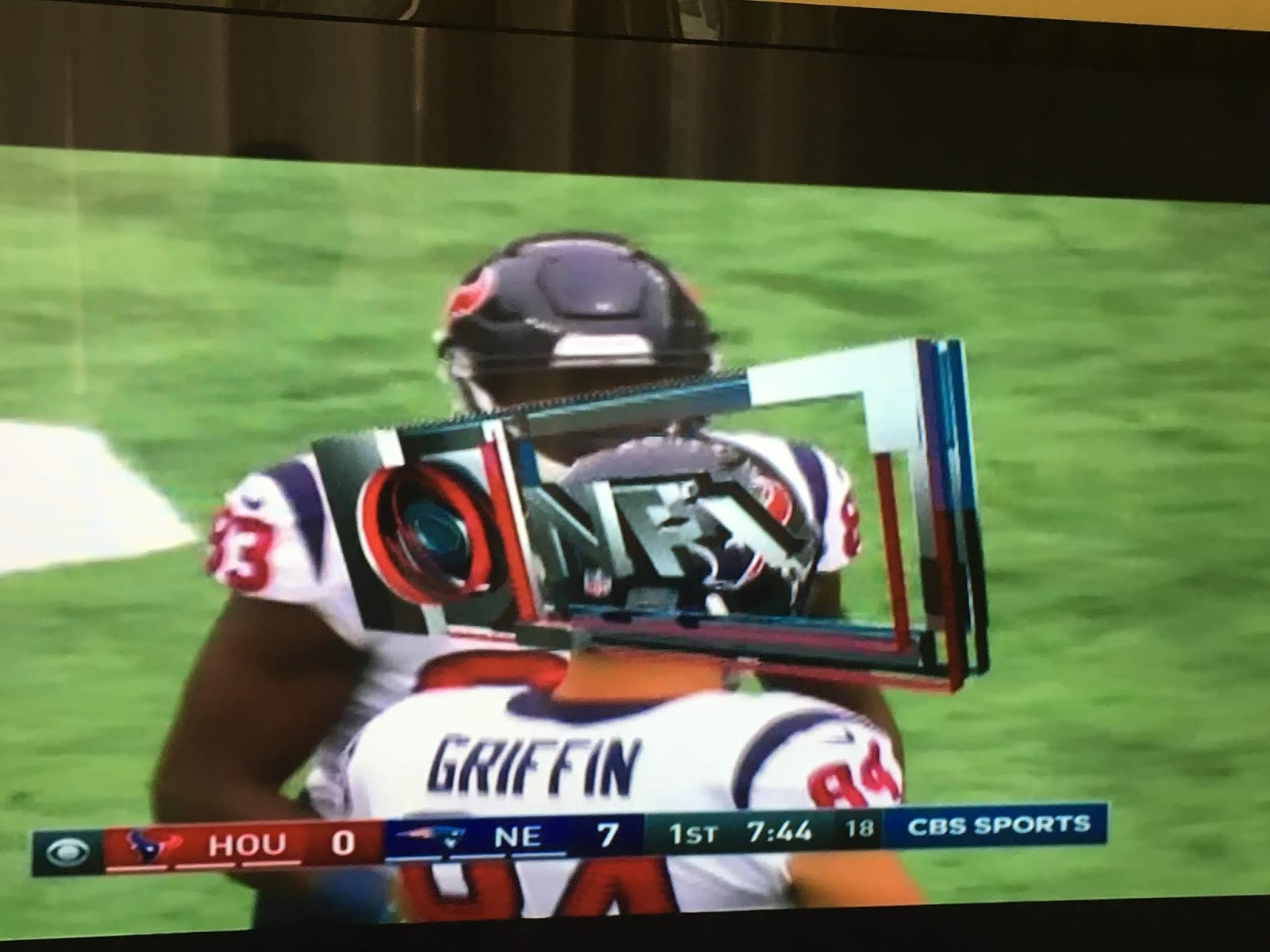
This is in particular a follow shot that follows the Patriots pass rusher, as this time he is able to secure a sack on the quarterback. The shot actually, for me, invoked fear as I imagined my self being hit by a 300 pound linebacker.
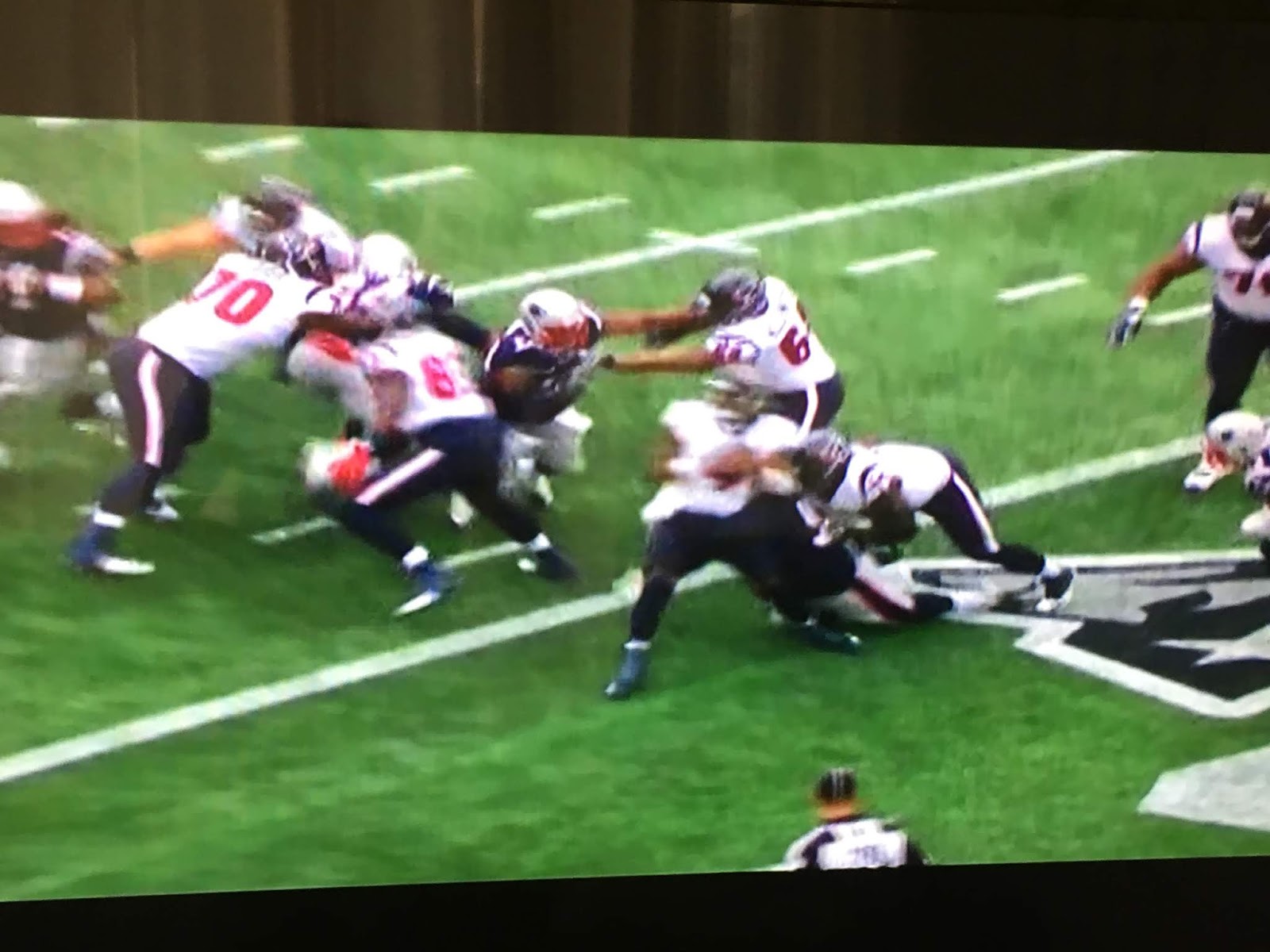
Finally, this shot here is known as an over the shoulder shot. As you see the camera is looking over the referee as Watson is sacked for a second time. More than any other angle does this shot make me feel like I'm actually on the field with the players experiencing the intensity and importance of the first game of the season. Overall, while finding the different camera angles was fun, I should of watched Tampa Bay, because this was game was really boring.

Sunday, September 2, 2018
Classmate Video Reviews
The first comments I made were on Jairo's blog
- His extreme close up shot made me feel the very fear that the character felt, and for a moment I could even see the reflection of what he was looking at, which gave me chills.
- The freeze frame shot took me by surprise because I thought the video was buffering, because it looked so real.
- The choker shot made me feel like I was trapped, and had nowhere to hide, as I felt that I shared his character's obstacles.
- The final shot I commented on was the point-of-View shot, which made me realize that everyone sees life with a different perspective.
Then I commented on Owen's bog
- I very much enjoyed Owen's head on shot, because I almost felt what the character was going through as he contemplated and then punched Jairo.
- The point-of View shot was fun to watch, and now I'm going to everyone trying to come up with cool handshakes like the one in this shot.
- The full shot was interesting, because it was of Jairo and Jairo's full shot was of Owen, so I was able to see two sides of one world.
- The establishing shot was also nice because it allowed me to take a break from my daily life and become a mailman.
Subscribe to:
Posts (Atom)